German Rouladen
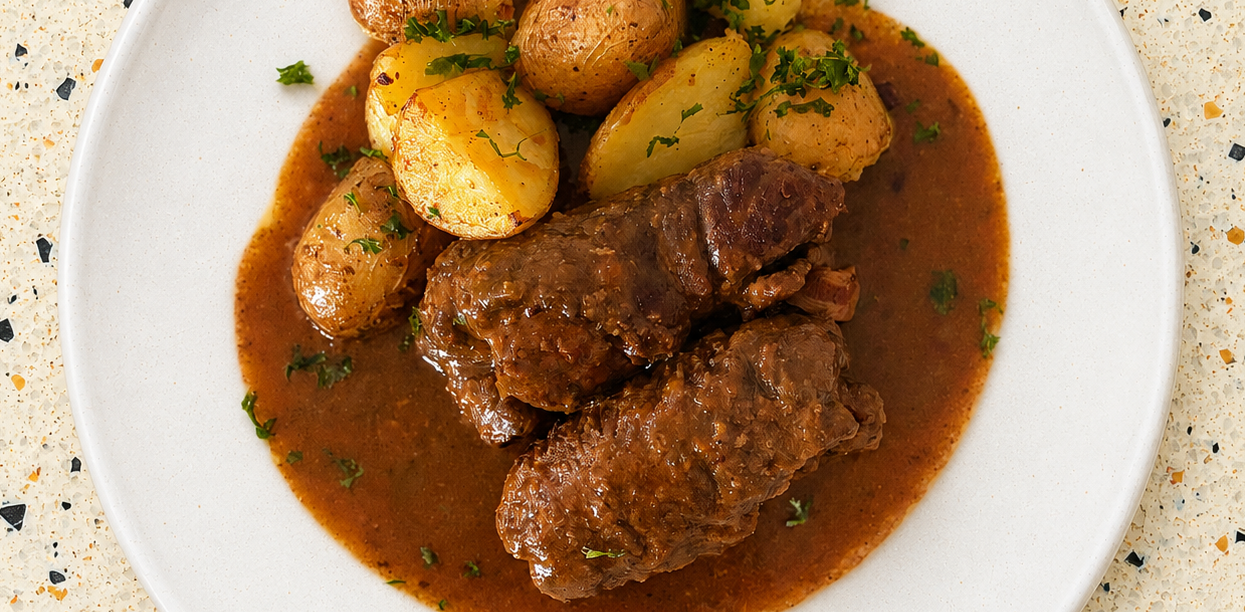
Rouladen are thin slices of beef rolled around a filling of mustard, bacon, onion and pickles, which are braised slowly until tender. Rouladen are simmered in a dark, rich gravy and served with potato dumplings (Kartoffelklöße), boiled or roasted potatoes and red cabbage. A favorite Sunday-dinner and a traditional meal during Christmas time in Germany
Ingredients
- 4 thin beef top round slices ( about 6–7 oz / 170–200 g, each ) pounded to ¼ inch / 6 mm thick)
- 4 tsp German or Dijon mustard or more as needed
- Salt and black pepper, to taste
- 4-8 slices bacon
- 2 medium yellow onion, finely diced
- 4-8 medium pickles, slices into thin spears
- 2 Tbsp neutral oil (sunflower or vegetable)
- 1 medium carrot, thinly sliced
- 1 stalk celery, roughly chopped
- 2 Tbsp tomato paste
- 1 cup (240 ml) dry red wine
- 2 cups (480 ml) strong beef broth, or more if needed
- 1 bay leaf
- 4 whole allspice berries
- 1 Tbsp cornstarch, optional, to thicken gravy
- 2 Tbsp cold water, if using cornstarch
- Kitchen twine or toothpicks, for securing the Rouladen
Preparation
Lay the beef slices flat on a work surface. If they have not been pounded thin by the butcher, take a piece of cling film and pound thin to about 1/4 inch thickness. Season with salt and black pepper on both sides. Spread 1 teaspoon of mustard over each slice, going nearly to the edges.
Place 1 slice of bacon lengthwise on each beef slice. Distribute the diced onion evenly over the bacon on each slice. Distribute the pickle spears over the bacon almost to the edges.
Starting from one edge, roll each slice tightly, tucking in the sides inward as you go to enclose the filling. Tie with kitchen twine at two or three points, or secure with toothpicks. Set aside on a plate and sprinkle lightly with flour on all sides. This will help the browning of the rouladen.
Heat the oil in a heavy-bottomed skillet over medium-high heat. Work in batches if necessary, searing the Rouladen on all sides until well browned, 6–8 minutes total. Remove and set aside on a plate
Add a tablespoon olive oil to the same skillet, add the remaining onion, carrot and celery. Cook over medium heat, stirring occasionally, until lightly colored, about 3 minutes. Stir in the tomato paste and cook for 1 minute. Pour in the red wine, scraping up the browned bits from the bottom. Let it reduce by almost half, about 3 minutes.
Return the Rouladen to the saucepan. Add the beef broth, bay leaf, and allspice berries. The braising liquid should come about two-thirds of the way up the rolls. Bring to a gentle simmer, then cover and cook over low heat for 1 hour 30 minutes, turning the rolls once halfway through, until the beef is tender when pierced with a skewer.
Transfer the Rouladen to a plate and remove the twine or toothpicks. Strain the braising liquid through a fine-mesh sieve into a saucepan. Discard bay leaf and allspice berries. Save some of the solids ( onions,carrot, celery ). Pour braising liquid and some of the solids in a mixer, adding enough liquid to reach a consistency to your liking. Pour braising sauce in a saucepan and bring it to a simmer over medium-low heat and cook until for 5–8 minutes.
Return the Rouladen to the gravy to warm through for a few minutes. Adjust seasonings.
Notes
Beef cut: Top round (also sold as “round steak” or “beef for Rouladen” at German butchers) is the traditional choice. If rouladen beef is long, and you are able to make 2 rouladen of 1 beef slice, do it. Shorter pieces of beef are easier to roll, make for a quicker cooking and nicer smaller rouladen.
Pickle: Use a firm, vinegar-brined pickle. Do not use a sweet or bread-and-butter pickle. The pickle acidity is part of the flavor balance.
Advance prep: Rouladen reheat very well. You can braise them a day ahead, refrigerate in the gravy, and reheat gently on the stove top. The flavor improves overnight.
Gravy thickness: Some cooks prefer a thinner, more concentrated gravy . If you do use cornstarch, add it gradually — you can always add more but cannot remove it.
Comments